
Consulting
Business plans, financial models and feasibility studies in Kazakhstan
We produce the documents that funding decisions are made on: business plans for banks and investors, feasibility studies, financial models with NPV, IRR and PI, and applications for subsidies and state support programmes.
- Business plans built to a specific bank's or fund's requirements
- Financial models: NPV, IRR, PI, payback period
- Technical and economic feasibility studies
- Subsidies, state programmes and representation before authorities
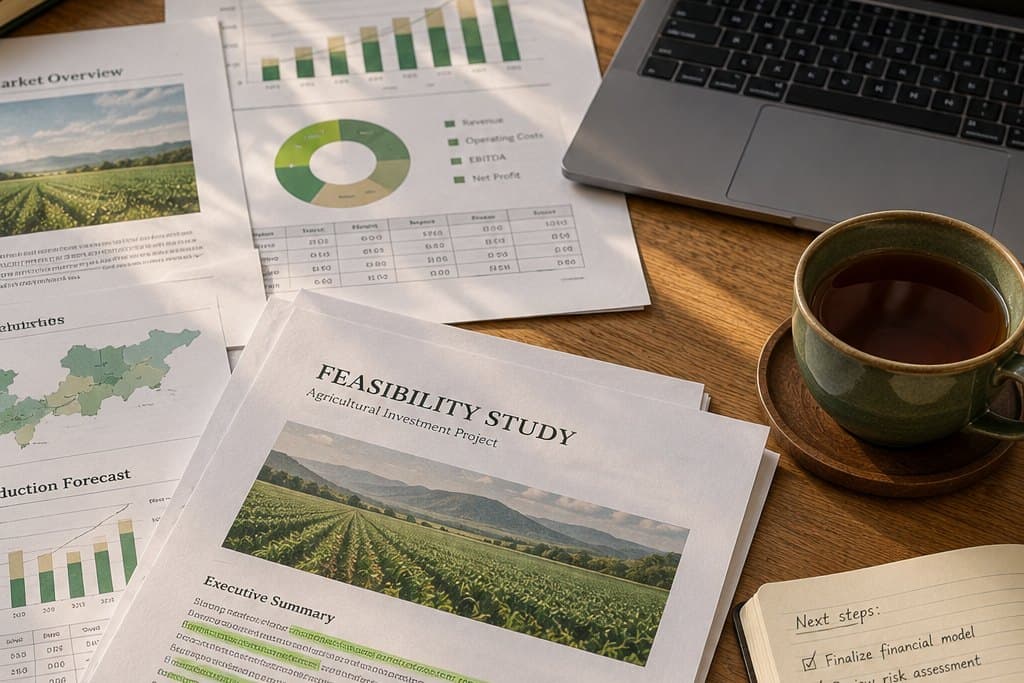
A document that clears the credit committee
A bankable business plan and a business plan written for internal use are different documents. A credit committee does not look at a polished deck; it looks at whether the assumptions are justified, where the numbers come from, how sensitive the model is to price movements and whether the repayment schedule is realistic. We build to the requirements of the specific lender rather than to a universal template.
State support is a separate layer. Kazakhstan runs several subsidy and concessional finance programmes, each with its own requirements for the application and supporting documents. More applications are rejected here on formal non-compliance than on weak project economics.
Services
What we produce
Documents and calculations for financing and state support.
Financing documents
- Business plan built to the lender's requirements
- Investor business plan and information memorandum
- Technical and economic feasibility study
- Excel financial model with cash flow forecast
- NPV, IRR, PI and payback period calculations
- Sensitivity analysis and scenario modelling
State support
- Identifying applicable subsidy programmes
- Preparing subsidy and concessional finance applications
- Assembling supporting documents
- Representation before state authorities
- Support through review and responses to comments
Step
How the work runs
From defining the brief to defending the document.
Step 1
Defining the brief
We establish who the document is addressed to: a specific bank, fund, investor or state programme. That determines the structure, the depth of the calculations and the set of annexes.
Step 2
Data and assumptions
We collect the project inputs: capital costs, technology, market, prices, cost of sales, staffing. Assumptions are documented in writing — they are exactly what the credit committee scrutinises.
Step 3
Model and document
We build the financial model with a cash flow forecast and performance indicators, and write the narrative, marketing and production sections along with the risk analysis.
Step 4
Submission and defence
We assemble the package to the recipient's requirements, support the submission, handle questions and comments and, where needed, represent you before state authorities.
What we need from you
The more precise the inputs, the stronger the document holds up under scrutiny.
- Project description and current stage
- Capital cost estimate or supplier quotations
- Technology and production capacity data
- Target market information and planned pricing
- Financial statements, if the business is already trading
- Details of collateral and own contribution
- The bank's, fund's or programme's requirements, if already known
If some of the data does not exist yet, we help build it — that is a normal part of working on a greenfield project.
What the work covers
The document is taken through to a result, not simply handed over.
Financial model
A transparent Excel model with open formulas you can audit and re-run against new inputs.
Business plan and feasibility study
Structure and depth of analysis matched to the specific recipient of the document.
Risk analysis
Scenarios and sensitivity to prices, exchange rate and volumes — the questions that come up at committee.
Subsidies
We identify applicable programmes and prepare the application to their requirements.
Representation
We deal with state authorities and support the review process.
FAQ
Business plan and feasibility study FAQ
The essentials.
How does a feasibility study differ from a business plan?
A feasibility study answers whether the project is technically and economically viable: technology, capacity, costs, returns. A business plan is broader — it adds the market, sales strategy, organisational structure and funding plan. Banks more often ask for a business plan; industrial and infrastructure projects for a feasibility study. Sometimes both are required.
Do you build the document for a specific bank?
Yes, and it matters. Banks and funds differ in format, forecast horizon, annex structure and how assumptions must be justified. A generic business plan performs worse than one assembled to a particular lender's requirements.
What does the financial model include?
Profit and loss forecast, cash flow, balance sheet, funding and repayment schedule, NPV, IRR, PI and payback period, plus sensitivity analysis on the key parameters. The model is delivered in Excel with open formulas so you can re-run it yourself.
Can you support a subsidy application?
Yes. We identify the applicable programmes, prepare the application and supporting documents, support the review and respond to comments. A significant share of rejections comes down to incomplete documentation rather than the merits of the project.
How long does a business plan take?
Usually a matter of weeks, and the main variable is how quickly project data arrives. Where the cost estimate, technology and market are settled the work moves fast; where the project is still at concept stage, part of the data has to be built together with you.
Services
Related services
These usually run together in a single project.
Company registration
LLP, branch or representative office: constitutive documents, legal address, BIN, digital signature, tax registration and a bank account.
Learn moreFertilizer registration
Mineral and organic fertilizers, micronutrients, biostimulants and soil amendments — registration, trials and import documentation.
Learn morePesticide registration
Herbicides, fungicides, insecticides, seed treatments, desiccants and adjuvants — from trial strategy to listing in the state register.
Learn more
Let us discuss your project
Tell us about the project and who the document is for — we will propose a structure, timeline and price.
Mon–Fri 09:00 — 18:00